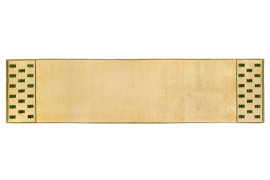
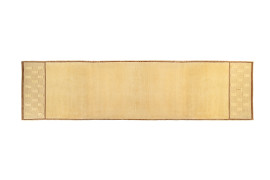
In Persian, Kamila means ‘perfect’ or ‘complete’ and symbolises harmony and inner wholeness. The carpet is created with the Souf technique, a rare, luxurious Persian rug-weaving method that creates a three-dimensional, carved effect by combining raised patterns against a flatwoven (Soumakh) ground. The combination of Souf, Soumakh and Amaleh knotting techniques (Zollanvari Fine Gabbeh) achieve a rich variety of textures. The combination of these techniques for use in large-format carpets was developed by Zollanvari especially for this project for Fischbacher 1819. The Fischbacher 1819 runners were made by the Afshar nomads in southeastern Shiraz. The design is inspired by a powerful historical Zoroastrian symbol from Khiva, which vertically represents the past, present and future, and horizontally depicts the winged human figure of Faravahar – a timeless symbol of consciousness and continuity. The symbol represents a guardian spirit. The symbol, raised by the Souf technique, is arranged in a border with a soumak background at the top and bottom of the runner. The border is finished with a narrow kilim strip. The centre of the runner is hand-knotted. The design strikes a balance between symbolic depth and modern clarity. Kamila is hand-knotted by Afshar craftswomen using traditional techniques and hand-spun sheep's wool dyed with natural dyes, translating spiritual heritage into a calm, contemporary surface. All carpets are made to measure on request.
Care
To maintain your carpet's appearance and longevity, vacuum it at least once a week using a standard vacuum cleaner. Use a brush roller for deeper cleaning once or twice a year. Professional cleaning is recommended every 1–2 years.